
Extensions Length Chart
Hair extension lengths are measured from the top of the weft or bond to the ends, so the same 18-inch hair looks longer on a petite person than on a tall one. Enter your height and where you want the ends to fall, and the chart suggests a length, shows where every common length will land, and estimates how many grams to buy for the fullness you want.
- Free to use
- No sign-up
- Runs in your browser
Extension length and weight planner
Hair Extensions Planning Pack
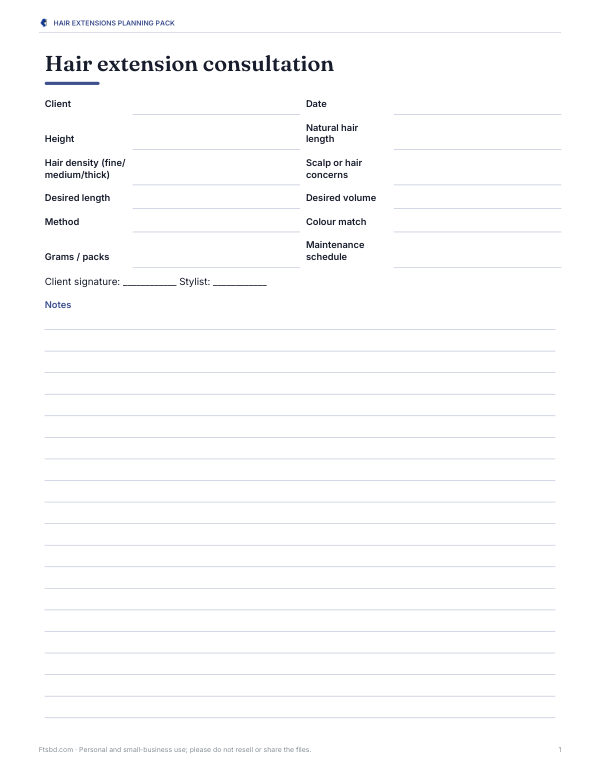
Printable extension length chart by height, a grams-needed guide, a client consultation form (DOCX), an aftercare card and an Excel appointment and maintenance log.
- Length chart (PDF)
- Grams guide (PDF)
- Consultation form (DOCX/PDF)
- Aftercare card (PDF)
- Maintenance log (XLSX)
Formats: PDF, XLSX, DOCX. Instant download after payment (link valid 72 hours, up to 5 downloads). AI-assisted: the templates were drafted with AI help and reviewed and laid out before publishing.
$3.00 USD, one-time 5 files · about $0.60 each
- Instant download
- 7-day refund
- Secure checkout by Stripe
7-day money-back guarantee. Full refund within 7 days of purchase, even after you download.
Free sample: Extension Aftercare Card (PDF, 63 KB)
Full refund within 7 days — see the refund policy and license.
Free printables
Single sheets you can print right now, no sign-up. The full pack adds every sheet in one download plus the editable files.
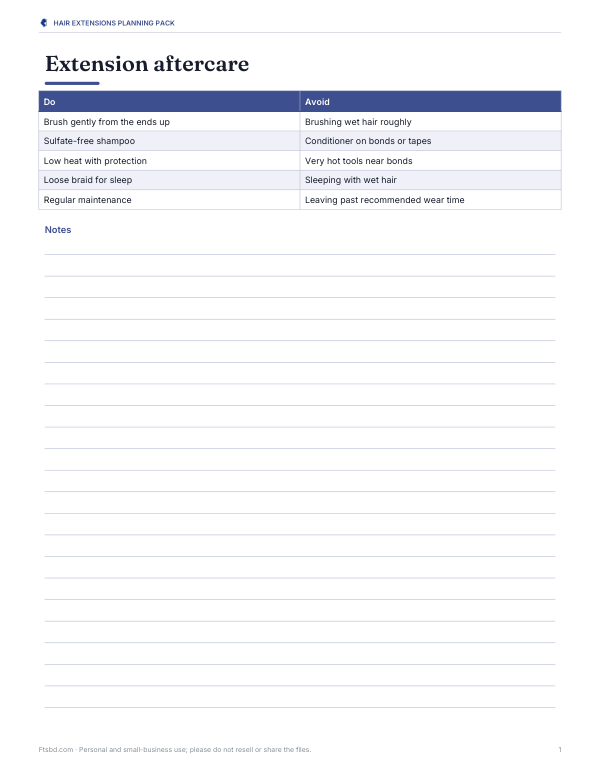 Printable Hair Extensions Aftercare Card
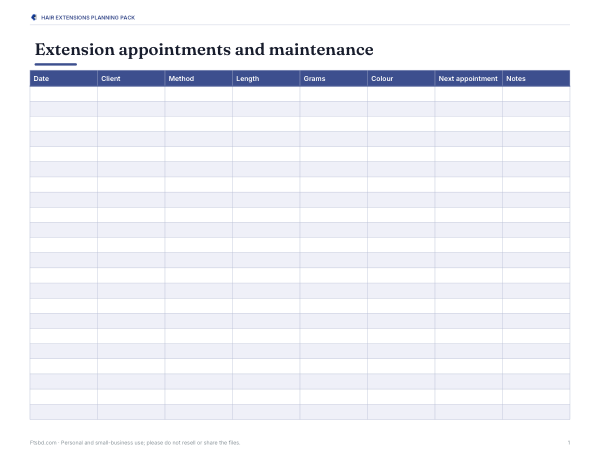 Hair Extensions Maintenance Log
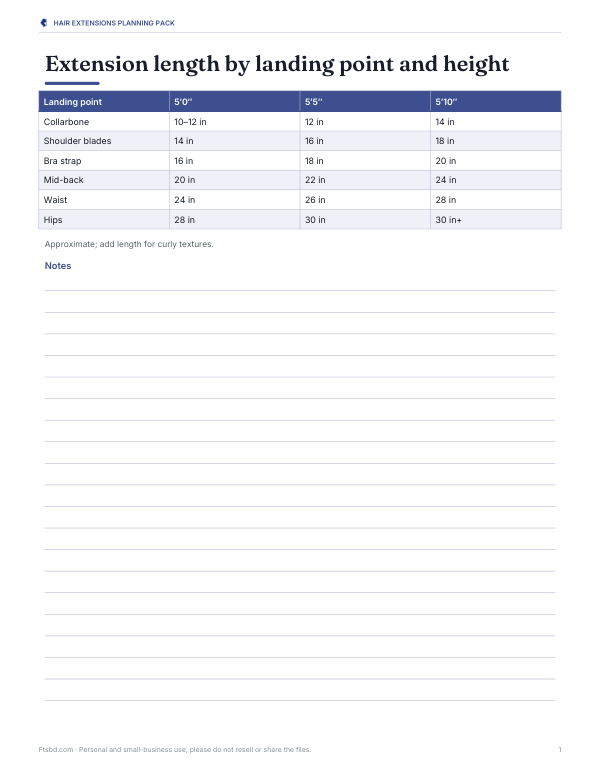
Where each length falls (average height, about 5′5″)
| Length | Typically falls at |
|---|---|
| 10–12 in | Chin to collarbone |
| 14 in | Just below the shoulders |
| 16 in | Shoulder blades |
| 18 in | Bra strap / upper back |
| 20 in | Mid-back |
| 22 in | Mid to lower back |
| 24 in | Just above the waist |
| 26 in | Waist |
| 28–30 in | Hips and below |
Length is measured from the top of the weft or bond to the tips. On a petite person (around 5′0″) each length falls lower; on someone tall (around 5′10″) it falls higher, so taller people often choose 2–4 inches longer for the same look. Layered and curly hair also looks shorter than its stretched length.
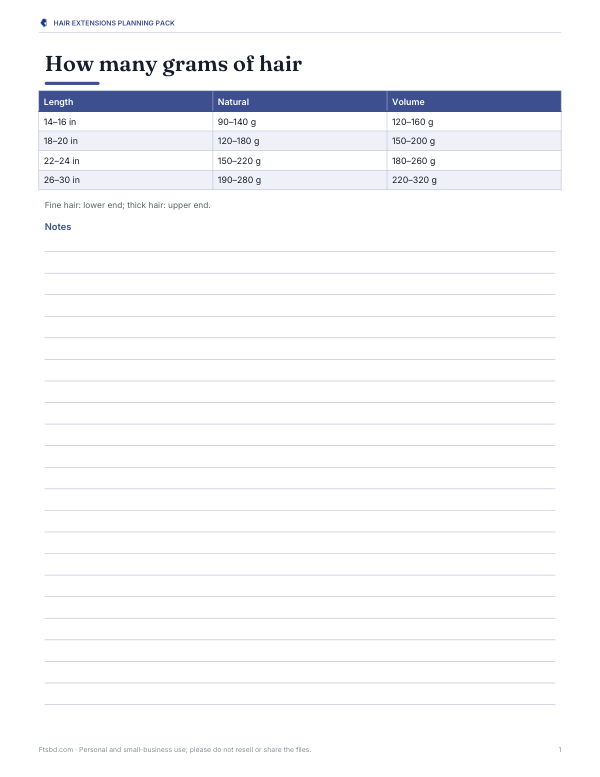
How much hair do you need?
| Length | Add length / natural (g) | Full volume (g) |
|---|---|---|
| 14–16 in | 90–140 | 120–160 |
| 18–20 in | 120–180 | 150–200 |
| 22–24 in | 150–220 | 180–260 |
| 26–30 in | 190–280 | 220–320 |
These ranges are typical starting points for a full head. Fine hair needs less to blend (too much can look bulky and strain the hair), while thick hair needs more for the extensions to show. Longer hair needs more grams because the ends thin out.
Choosing a method
| Method | Wear time | Notes |
|---|---|---|
| Clip-in | Daily, removed at night | No commitment; easiest for beginners |
| Tape-in | 6–8 weeks, then re-taped | Flat, discreet; needs a stylist |
| Keratin bond (fusion) | 3–4 months | Individual strands; natural movement |
| Micro-link / bead | 2–4 months | No heat or glue; moved up as hair grows |
| Sew-in / weft | 6–8 weeks | Braided base; common for thick or textured hair |
| Halo / wire | Daily | Sits on the head with a clear wire; no attachment |
Measuring for the right length
- Decide where you want the ends to fall and hold a tape measure there.
- Measure from about where the top row will sit — usually just below the crown — down to that point.
- Add an inch or two for layering and blending with your own ends.
- For curly or wavy extensions, add 2–4 inches to allow for curl shrinkage.
- Compare with the chart and your height.
Blending tips
- Your own hair should reach at least the chin or jaw for most methods, so the tops of the wefts are hidden.
- Match colour in daylight; many people blend two shades.
- Ask a stylist to cut the extensions and your hair together for a seamless finish.
- Choose a texture that matches your natural hair or how you style it.
- Place the top row at least an inch below your parting.
Worked example
A 5′3″ client with fine, shoulder-length hair wants the ends at mid-back with a natural look. The planner scales the 22-inch reference for her height and suggests 20 inches, with about 120–150 grams — one or two clip-in sets. Because her hair is fine, it recommends staying at the lower end so the extensions blend without looking heavy.
Matching colour and texture
Colour-match extensions to the ends of your hair, not the roots, because ends are often lighter. Look in natural daylight and, if your hair has highlights, blend two shades or choose a highlighted set. Match texture too: silky straight extensions look out of place with naturally wavy or coily hair, so choose body wave, kinky straight, curly or coily textures to suit your own. Remy human hair (with cuticles aligned) tangles less and can be heat styled; synthetic hair is cheaper but less versatile.
How long extensions last
| Type | Typical lifespan with care |
|---|---|
| Synthetic clip-ins | A few months of regular wear |
| Human hair clip-ins | 6–12 months or more |
| Tape-ins | Hair reused for 2–3 applications |
| Keratin bonds | 3–4 months per application |
| Wefts / sew-ins | Hair reusable for several installs |
Lifespan depends on hair quality, washing frequency, heat styling and care.
Caring for extensions
- Brush gently from the ends upward with a loop or soft-bristle brush.
- Use sulfate-free shampoo and condition the lengths, not the bonds.
- Air-dry or use low heat; protect with heat spray before styling.
- Sleep with hair in a loose braid or on a silk pillowcase.
- Store clip-ins flat or hanging, away from sunlight.
Privacy
The planner runs in your browser; your details are not stored.
Frequently asked questions
Where do 18-inch extensions fall?
Around the bra strap on someone about 5′5″; lower on petite people and higher on tall people.
How many grams of hair do I need?
Commonly 100–160 g for a full head at 14–18 inches, more for longer or fuller looks.
Is extension length measured from the scalp?
From the top of the weft or bond to the ends.
Should I get longer extensions if I’m tall?
Often 2–4 inches longer for the same landing point.
Do curly extensions look shorter?
Yes, curl pattern shortens the visible length.
Can I dye human hair extensions?
Usually darker, not lighter; ask a colourist, as bleaching can damage them.
Can I wear extensions with short hair?
Usually your hair should reach at least the chin to hide the attachments; ask a stylist.
How often do tape-ins need moving up?
About every 6–8 weeks as your hair grows.
Are clip-ins damaging?
Worn correctly and removed at night, clip-ins are among the gentlest options.
Is my data stored?
No, it runs in your browser.